Partitioning in Trees and Soil (PiTS) Part 1 - Loblolly Pine
- A field research facility for developing dynamic carbon and nitrogen partitioning representations for global models and
applications.
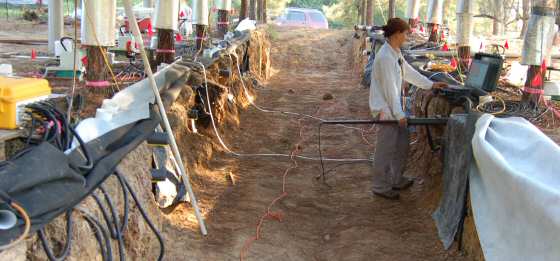
"Belowground observation
units are placed in a large pit
dug to a depth of 1
meter, adjacent to eight
trees. Instruments are
placed above and below
ground to track carbon
dynamics."
Members of the Oak Ridge National Laboratory (ORNL) research team conducting the experiment state that the objective of this
experiment "is to improve the carbon partitioning routines in existing ecosystem models based on the concepts gathered
from plant partitioning models and tested against field observations and manipulations." They propose "to use short-term,
comprehensive field measurement of processes related to carbon partitioning from leaves to roots and roots to soil." The experiment focuses on "belowground carbon
partitioning." They further state that "An improved understanding of the relative
amount and fate of belowground partitioning will lead to improvements in model representation of carbon partitioning and
the fate of carbon under elevated carbon dioxide and other climate perturbations".
Experiment Background
According to the team, the starting point for models of ecosystem carbon cycling, "is with a representation of
photosynthetic assimilation of atmospheric carbon dioxide by vegetation." The next step is to model how a plant internally
distributes carbon, a process called carbon allocation or partitioning.
In their description of the experiment, the team states how studies have shown that "an incomplete understanding of
carbon partitioning currently limits the capacity to model forest ecosystem metabolism and accurately predict the effects
of global change on carbon cycling." In particular, they cite the need for ecosystem model improvements "in their
representation of partitioning to belowground structures and processes because plant-soil interactions are central to the
biogeochemical cycles of carbon, nitrogen, and water, and they are important for modulating climate change impacts and
regulating feedbacks of greenhouse gas emissions."
According to the team, "by coupling short term experimental manipulations with intensive measurements above- and
belowground, we will advance our understanding of the biological and environmental influences on carbon partitioning,
and their consequences for carbon-nitrogen interactions in plant and soil."
Experiment Construction
Eight loblolly pine (Pinus taeda) trees - less than 10
meters in height - have been chosen for the
experiment. Belowground observation units are
placed in a pit, dug to a depth of 1 meter, adjacent
to the trees. Instruments are placed above and
below ground to track carbon
dynamics.
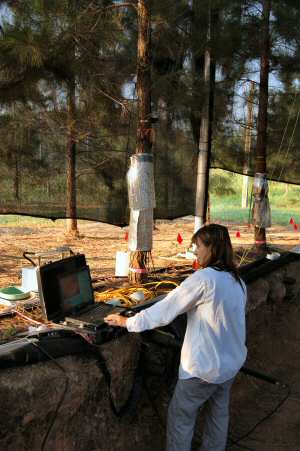
Total carbon uptake by the trees is calculated from measurements of Photosynthetic Active Radiation (PAR) by sensors above the tree canopy, transpiration by sapflow gauges on the stem, and leaf-level photosynthesis using gas exchange cuvettes, with access to the canopy provided by a hydraulic lift. In the belowground
system, minirhizotron tubes track the timing and amount of root growth. Root observation windows allow access to newly produced roots for chemical analyses.
Also, carbon dioxide analyzers, soil gas and water
samplers provide additional data on carbon and water dynamics in the soil.
The experiment is designed so that the carbon balance of the tree canopy can be altered. This provides data on how the
carbon flux belowground varies with short-term changes in the canopy-integrated stomatal conductance and
photosynthesis.
On September 1, 2010, the ORNL researchers enclosed the pines in a large plastic chamber and released carbon dioxide that was highly enriched in the non-radioactive, stable isotope 13C. The researchers are currently tracking the 13C signal in the leaves, wood, roots and soil in order to determine where carbon dioxide taken up during photosynthesis is partitioned within the tree and soil system.
During the course of the experiment, the team anticipates many other manipulations, including nitrate or ammonium applications to specific locations - at different depths - to measure root-specific nitrogen
uptake rates as a function of soil depth. They also cite the value of the
chosen facility's flexibility.
Model Interaction
According to the research team the "goal is to develop and test a
dynamic carbon partitioning module that will be integrated into the
Community Land Model (Thornton et al., 2007)*. This goal will need to be achieved without
substantially increasing the computational burden of the model, which is designed for global-scale operations. Thus it is
important to find out what processes are essential and how to
represent them efficiently." They plan to "start from the dynamic,
individual tree based carbon partitioning model and then
progressively simplify its structure to reach a balance between
computational demand and process representation." They describe
the model as operating "at half-hourly time steps" and "driven by
meteorological measurements at the site." "Sugar measurements at
different positions of the tree and different times of the day and the
season will be used to test model behavior. Allometric relationships
obtained with destructive sampling at the end of the study will be
used to test the long-term integration of the model."
Phase 1 of the experiment - the first of three phases - began in April
2010 with the digging of the pit and placement of the measuring
instruments. Observations during the 2010 summer growing season
have generated preliminary data for use in evaluating the second
phase of the experiment and for input in the dynamic carbon
partitioning model. Phase 2 is scheduled to begin in December 2010.
Members of the ORNL research team include:
ORNL Environmental Sciences Division Richard J. Norby, Task leader Colleen M. Iversen, Plant-soil interaction Charles T. Garten, Jr., Stable isotope labeling David J. Weston, Physiological/biochemical measurements Jeffrey Warren, Sap flow and water relations Peter E. Thornton, Ecosystem model Lianhong Gu, Physiological model Joanne Childs, Minirhizotron measurements University of Tennessee Institute Of Agriculture Jennifer Franklin, Associate Professor, Department of Forestry, Wildlife and Fisheries
*Thornton PE, Lamarque JF, Rosenbloom NA, Mahowald NM. 2007. Influence of carbon-nitrogen cycle coupling on land model response to CO2 fertilization and climate variability. Global Biogeochemical Cycles 21:15.
Empirical results from the initial FRREC PITS experiment in loblolly pine were published in: Warren JM, Iversen CM, Garten CT, Norby RJ, Childs J, Brice DJ, Evans RM, Gu L, Thornton PE, Weston DJ (2012). Timing and magnitude of carbon partitioning through a young loblolly pine (Pinus taeda L.) stand using 13C labeling and shade treatments. Tree Physiology, 32:799-813.

 "Belowground observation
units are placed in a large pit
dug to a depth of 1
meter, adjacent to eight
trees. Instruments are
placed above and below
ground to track carbon
dynamics."
"Belowground observation
units are placed in a large pit
dug to a depth of 1
meter, adjacent to eight
trees. Instruments are
placed above and below
ground to track carbon
dynamics."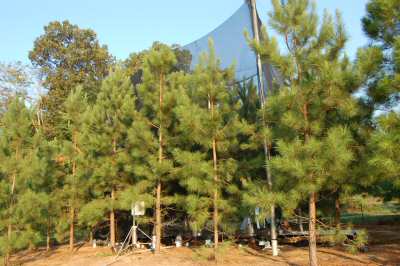 Eight loblolly pine (Pinus taeda) trees - less than 10
meters in height - have been chosen for the
experiment. Belowground observation units are
placed in a pit, dug to a depth of 1 meter, adjacent
to the trees. Instruments are placed above and
below ground to track carbon
dynamics.
Eight loblolly pine (Pinus taeda) trees - less than 10
meters in height - have been chosen for the
experiment. Belowground observation units are
placed in a pit, dug to a depth of 1 meter, adjacent
to the trees. Instruments are placed above and
below ground to track carbon
dynamics.
 According to the research team the "goal is to develop and test a
dynamic carbon partitioning module that will be integrated into the
Community Land Model (Thornton et al., 2007)*. This goal will need to be achieved without
substantially increasing the computational burden of the model, which is designed for global-scale operations. Thus it is
important to find out what processes are essential and how to
represent them efficiently." They plan to "start from the dynamic,
individual tree based carbon partitioning model and then
progressively simplify its structure to reach a balance between
computational demand and process representation." They describe
the model as operating "at half-hourly time steps" and "driven by
meteorological measurements at the site." "Sugar measurements at
different positions of the tree and different times of the day and the
season will be used to test model behavior. Allometric relationships
obtained with destructive sampling at the end of the study will be
used to test the long-term integration of the model."
According to the research team the "goal is to develop and test a
dynamic carbon partitioning module that will be integrated into the
Community Land Model (Thornton et al., 2007)*. This goal will need to be achieved without
substantially increasing the computational burden of the model, which is designed for global-scale operations. Thus it is
important to find out what processes are essential and how to
represent them efficiently." They plan to "start from the dynamic,
individual tree based carbon partitioning model and then
progressively simplify its structure to reach a balance between
computational demand and process representation." They describe
the model as operating "at half-hourly time steps" and "driven by
meteorological measurements at the site." "Sugar measurements at
different positions of the tree and different times of the day and the
season will be used to test model behavior. Allometric relationships
obtained with destructive sampling at the end of the study will be
used to test the long-term integration of the model."


