American Holly (Ilex opaca)
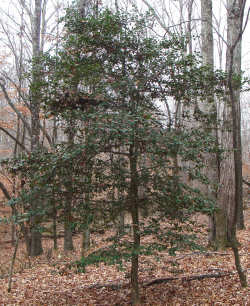 American Holly is found as an understory tree in a variety of habitats throughout the Arboretum. Although it can grow to heights of 50-60 feet, most of the trees along our trails are much smaller, reflecting their slow growth rate and the relatively recent disturbance history of our forests. After the leaves have fallen, these trees become more readily visible with their spiny, evergreen leaves.
American Holly belongs to a large genus of more than 400 different species found around the world. The range of this species extends from southern New England to Florida, and west to eastern Texas and southern Missouri. A row of large American Holly cultivars was planted along Valley Drive in the mid-1960's when the Arboretum was first established. Some other American Holly cultivars can be seen in the Harold Elmore Holly Garden.
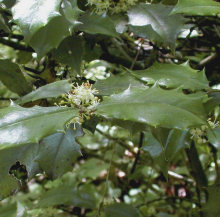
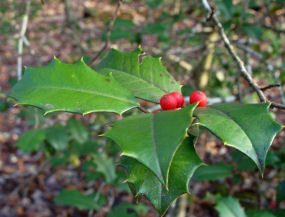 American Holly is distinguished by its simple, leathery, evergreen, spine-tipped leaves and its light gray bark. It is dioecious, bearing male and female flowers on separate plants. The small greenish-white flowers appear in late spring, and the red fruits mature on the female plants in late fall and persist into the winter. The fruits (4-seeded drupes) are collected along with the leaves for Christmas wreaths and other holiday decorations. The fruits are eaten by birds and small mammals, but can be toxic to humans and pets. The wood is suitable for inlays in cabinet work, handles, carvings, rulers, and scientific instruments. When dyed black to resemble ebony, the wood is used for violin pegs, piano keys, and fingerboards.
Return to Shrubs and Vines List
|
