Japanese Elm (Ulmus davidiana var. japonica)
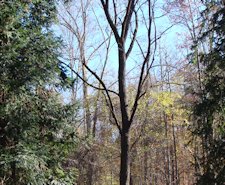 In the 20th Century Dutch Elm Disease (DED) devastated American Elms (Ulmus americana) throughout the Eastern US. To find a replacement for this common street tree, several elm species native to Asia were identified that were resistant to DED. Japanese Elm has been used extensively in breeding programs in the US, Canada, and Europe, and a number of resistant hybrids have been developed.
 In 1966 a specimen of Japanese Elm was planted in the Arboretum’s Central China Collection near the end of Marsh Road. Arboretum records list this tree as a cultivar of Japanese Elm — Ulmus japonica ‘Keki.’ Current taxonomy considers Japanese Elm to be Ulmus davidiana var. japonica, and the cultivar ‘Keki’ does not appear to be a currently recognized taxon. Our specimen may well be one of the hybrids tested for resistance to DED, but then not selected for further research.
 Japanese Elm makes an excellent shade tree, growing to heights of 50-80 ft. It has large, bright green leaves that are up to 4 inches long. As with a number of other elm species, the prominent leaf veins are parallel and the leaf base is asymmetrical. The wood has been used for pallets, crates, and firewood, and the tree is also used in Bonsai.
Return to Tree List
|
