Alders (Alnus spp.)
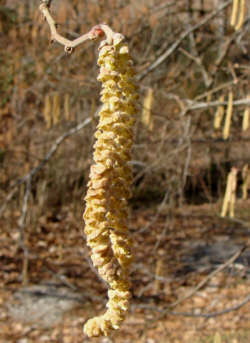 As spring approaches, two species of alder along Scarboro Creek below the Visitors Center come into bloom. The conspicuous male catkins which first appear in the late fall only shed their pollen in late January and early February. The pistils of the female cones emerge with warmer days.
The Seaside Alder (Alnus maritima) has an unusual distribution, being found on the Delmar Peninsula of Maryland and Delaware, in northern Georgia, and in Oklahoma. Recent studies suggest these disjunct (isolated) populations, left behind as the glaciers receded, have become distinct subspecies.

 Our native Hazel Alder (Alnus serrulata) ranges throughout the Eastern U.S. and west to Indiana, Missouri, Oklahoma and Texas. The fruits are found as clusters of cone-like structures that remain attached to the shrub throughout the winter.
Alders are generally associated with habitats such as stream banks, pond edges, and other wetlands. These shrubs are among a group of woody plants that have root nodules with symbiotic nitrogen-fixing bacteria. These bacteria convert inorganic nitrogen from the atmosphere to a form that can be used by plants. Studies have shown that the increased availability of nitrogen from alders can result in increased growth of trees planted in the same stands. Such studies support the idea that this nitrogen-fixing association enables alders to invade disturbed areas deficient in nitrogen.
Return to Wildflowers List
|
