Amur Honeysuckle (Lonicera maackii)
 One of the more troublesome invasive plants in our area is Amur Honeysuckle, a tall shrub (up to15-20 ft high) forming dense thickets that inhibit the growth of native plants. A native of central and eastern Asia, it was brought to North America as an ornamental in the late 1800's. It is an aggressive invader of edge habitats such as fence rows, the understory of secondary forests, and other previously disturbed areas. Amur Honeysuckle's ability to outcompete native species is associated with several characteristics: one of the first plants to leaf out in the spring and last to lose its leaves in the fall; its production of abundant seeds that are widely dispersed by birds and germinate readily; an aggressive growth rate; and its formation of dense shrubby thickets that shade out native understory plants. Research suggests that predation of nests is higher in Amur Honeysuckle than for native shrubs, and the nutritional value of its fruits for migrating birds is less than that of native plants.

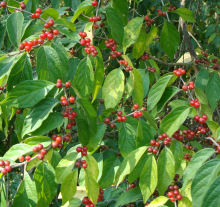 Its simple, opposite leaves are medium to dark green and up to 3.5 in. long, with long tapering tips. The white tubular, two-lipped, fragrant flowers appear in April and turn yellow with age, similar to those of Japanese Honeysuckle. The clusters of abundant, dark red, spherical fruits (berries) become conspicuous in September and persist into the winter months. Amur Honeysuckle is multi-trunked and shallow rooted. It has been used as an ornamental, for hedges and screens, and to attract wildlife. It is found in 24 states in the eastern and central U.S., and in our state is listed as a "Significant Threat" by the Tennessee Exotic Pest Pant Council.
Return to Shrubs and Vines List
Return to Tree List
|
