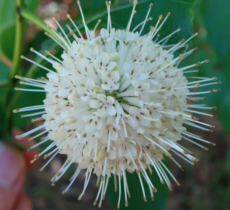
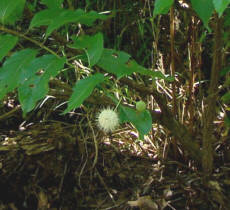
In early July, a Buttonbush located along Scarborough Creek near the entrance to the Arboretum displays the impressive white spheres of tightly compressed flowers that give rise to its common name. This shrub, a member of the Madder Family (Rubiaceae), may grow to a height of 20 ft. Its leaves are mainly
opposite, but whorls of three leaves may occur just below the inflorescence.
It occurs along the edges of wetland habitats such as stream banks and marshes from Southern Canada south to Florida and west to the Great Plains. It can also be found in New Mexico, Arizona, California and northern Mexico.
Although the leaves are poisonous to cattle, waterfowl and song birds eat the small nutlets, and the shrub provides excellent cover for a variety of birds and wildlife. Buttonbush has been used for medicinal purposes by
Native Americans. The bark contains an alkaloid, cephaeline, which is used in medications to induce vomiting, but it also contains cephalanthin, a poison that dissolves blood corpuscles.
Return to Shrubs and Vines List
|