Silk Tree or Mimosa (Albizia julibissin)
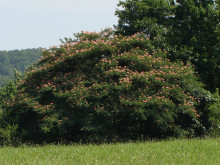

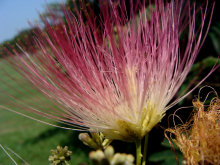
Silk Tree (commonly known as Mimosa) is found along highway and powerline rights-of-way, forest edges, and other disturbed areas. A native of Asia, it was introduced into North America as an ornamental during the 18th Century and is now considered an invasive plant - it is listed in the category "Severe Threat" by the Tennessee Exotic Pest Plant Council. A few trees occur at the Arboretum, but they have been managed as invasives and do not pose a significant problem. Silk Tree is a member of the bean family (Fabaceae) and has large twice-compound (bipinnate) leaves (up to 20 in. long); light to dark pink, thread-like flowers; and flat bean-like seed pods (5-7 in. long). The flowers attract hummingbirds, bees, and other insects. It is used as an ornamental throughout its range and has soil building properties related to nitrogen-fixing bacteria in its root nodules. Landscape ornamentals are susceptible to Mimosa Wilt which causes leaf yellowing and wilting in early and midsummer and results in death of the plants. Silk Tree produces abundant long-lived seeds, and it sprouts vigorously when cut back - features that promote its invasive character.
Return to Tree List
|
