Mistletoe (Phoradendron leucarpum)
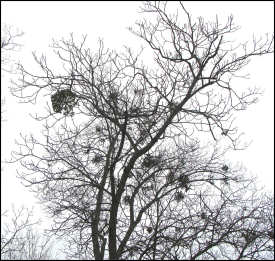 Clumps of Mistletoe resembling large green squirrel nests become conspicuous in the upper branches of deciduous trees after the leaves have fallen. Sprigs of its green leathery leaves and stems and its white berries are a familiar component of the Christmas time tradition of kissing under the Mistletoe. In ancient times it was used by Druid and pre-Christian traditions to decorate houses at the mid-winter and mid-summer solstices. In our area, Mistletoe is found on such trees as oaks, hickories, red maples, and sweetgums.
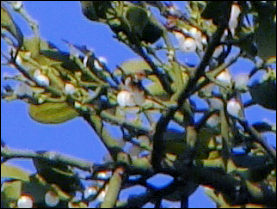
 Although not commonly found at the Arboretum, Mistletoe is frequently seen in Oak Ridge, Clinton, and along the Pellissippi Parkway. It is considered to be semi-parasitic because its modified roots penetrate the bark and vascular tissues of the host tree and access water and minerals for the developing plant, but it does not appear to harm the host. In the winter, Mistletoe clumps consist of a heavily branched system of greenish stems bearing opposite, leathery, leaves containing chlorophyll. While these clumps are heavily shaded by the host tree's canopy during the summer, they are well adapted to photosynthesize after leaf fall - it has even been suggested that they may contribute food to the host tree during the winter months.
Mistletoe bears inconspicuous yellow flowers and white, translucent berries. Birds disperse the seeds in their droppings and by wiping sticky residues of the fruits adhering to their beaks onto other trees. Phoradendron leucarpum occurs throughout much of the eastern US from New Jersey to Florida and as far west as Texas and Illinois. Species of Mistletoe in the western US are parasitic on conifers and can be a significant problem.
Return to Wildflowers List
|
