Oxeye Daisy (Leucanthemum vulgare)
 Populations of Oxeye Daisy are conspicuous near the upper end of Old Kerr Hollow Road, along Arboretum Drive, and along other trails at the Arboretum in early summer. The showy white flower with a bright yellow center was introduced from Europe in the 1800s and has spread throughout much of North America. Oxeye Daisy produces abundant seed, which remains viable for up to 6 years. It also spreads by vigorous vegetative reproduction of its root system. This invasive plant is listed as a noxious weed in at least five western states and in Ohio. The Tennessee Exotic Pest Plant Council lists Oxeye Daisy as a Rank 3 species (exotic plant species that spread in or near disturbed areas and are not considered a threat to native plant communities.)
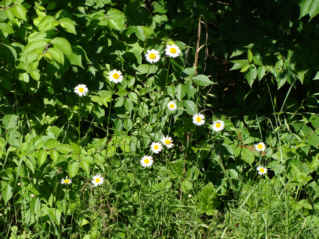 Oxeye Daisy is typically found in fields, waste places and other disturbed sites, as well as in the partial shade of open-canopy forests and along forest edges. The individual flower heads, which may be up to 2 inches in diameter, consist of sterile white ray flowers surrounding the yellow disk flowers in the center. Oxeye Daisy has been used for a variety of medicinal purposes and for making wines and tonics.
Return to Wildflowers List
|
