Paperbark Maple (Acer griseum)
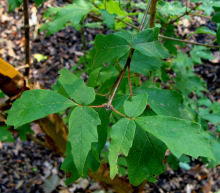
 A recent addition to the Arboretum's tree collection is a young Paperbark Maple planted behind the Visitors Center. It was donated by Ann and Lou Arnold in memory of Dr. Ted Rogers, a long-term supporter of the Arboretum and past President of the UT Arboretum Society. The most striking feature of this species is its exfoliating, papery bark that is brown to reddish brown, peeling away to a cinnamon to orange-brown color. Its opposite, compound, trifoliate leaves are dark green turning to an orange-red color in the fall.
 Paperbark Maple is a slow growing tree and is used primarily as an ornamental specimen for a variety of landscape settings as well as for Bonsai.
Paperbark Maple is a native of central China and grows 20-35 ft in height. It was introduced into the U.S. by E. H. Wilson in 1907 through the Arnold Arboretum.
Paperbark Maple is a slow growing tree and is used primarily as an ornamental specimen for a variety of landscape settings as well as for Bonsai.
Paperbark Maple is a native of central China and grows 20-35 ft in height. It was introduced into the U.S. by E. H. Wilson in 1907 through the Arnold Arboretum.
In the 1990's, the North America-China Plant Exploration Consortium (NACPEC) undertook efforts to collect additional specimens from China to enhance the genetic diversity of the U.S-propagated Paperbark Maples, all of which were apparently derived from the first introduction.
Return to Tree List
|
