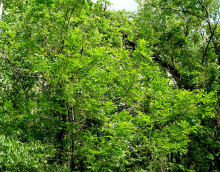
White Ash is found throughout Tennessee on a variety of dry to wet sites. It is a subdominant member of the Eastern Deciduous Forest, ranging from Nova Scotia to northern Florida, and west to eastern Nebraska and eastern Texas. It is fast-growing and can attain heights of 60 to over 100 ft. The opposite leaves are pinnately compound with 5-9 leaflets (typically 7). It is generally dioecious with male and female flowers borne on separate trees. The inconspicuous flowers appear in April, and the fruits (winged samaras) develop in late May to June and mature in the fall. White Ash provides cover, nesting cavities, and food for a variety of wildlife and birds. Its wood is valuable due to its strength, hardness, weight, and shock resistance. It is used for tool handles, oars, sports equipment (e.g., the Louisville Slugger and tennis rackets), and furniture. Apparently in the past, hunters have placed ash leaves in their boots and clothing to protect themselves from rattlesnake bites.
The Emerald Ash Borer (EAB), an exotic beetle from Asia, has killed millions of ash trees in the Eastern U.S. and has recently expanded its range into Tennessee. Its larvae feed on the inner bark of the trees, destroying the functional xylem and phloem that transport water and nutrients throughout the plant. The Tennessee Department of Agriculture has established EAB quarantines for 18 counties in Tennessee (including Anderson County) to limit the spread of this insect by restricting transport of firewood, mulch, and other wood materials from county to county. Many ash trees in Oak Ridge are already dead or damaged beyond the point where they can be saved.
Return to Tree List
|