White Oaks (Quercus spp.)
Several types of white oaks are producing abundant acorns this year. The acorn production (mast) from these oaks provides an important food for such animals as deer, squirrels, turkeys, and bears. The acorns of white oaks need 1 year to mature; red oaks require 2 years. White oaks have lobed leaves or ones with rounded teeth, while red oaks generally have sharp-lobed, bristle-tipped leaves.
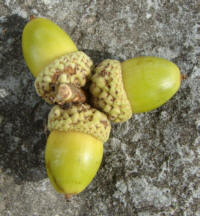
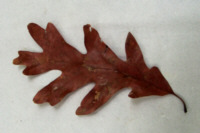 White Oak (Q. alba) is one of the most
common oaks found along Arboretum trails. Its acorns, which occur in clusters of two or three, are often green when they first fall but at maturity are a rich brown.
White Oak (Q. alba) is one of the most
common oaks found along Arboretum trails. Its acorns, which occur in clusters of two or three, are often green when they first fall but at maturity are a rich brown.

 Chestnut Oak (Q. montana) is also common along our trails and is especially conspicuous along the Lost Chestnut Trail. The large (up to 1 1/2 in.) acorns have a thin, warty cap and are shiny and brown to black at maturity.

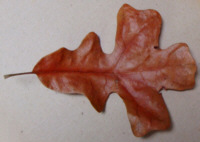 Scattered individuals of Post Oak (Q. stellata) are found at the Arboretum. Typical leaves are broader at the top and often resemble a cross. The relatively small acorns (up to 3/4 inch long) are covered for 1/3 to 1/2 their length by a bowl-shaped cup.
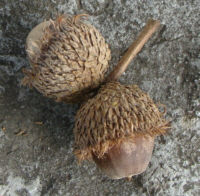
 The range of Bur Oak (Q. macrocarpa) extends into northwestern Tennessee, but is centered in the Midwest. Several individuals are found in the Oak Collection near the Program Shelter. Bur Oak has broad spatulate leaves and produces large acorns (up to 2 inches long) with a distinctive fringed cup.
Return to Tree List
|
