Yellow Anise (Illicium parviflorum)
 Yellow Anise is a rare native species of central Florida where it is a state-listed endangered species. It is also found in southern Georgia, but is considered to have escaped from cultivation there. It is used as a hedge plant in landscaping throughout much of the Southeast. A robust example of Yellow Anise can be seen east of the Program Shelter in the Shade Tree Collection. Yellow Anise belongs to the same genus as Star-Anise (Illicium vernum), found in China and Vietnam and used as a substitute for the culinary spice anise prepared from the unrelated plant Aniseed (Pimpinella anisum).
Yellow Anise is a dense shrub or small tree that typically grows to a height of 15-20 ft. It produces multiple stems where its branches touch the ground and develop roots by suckering. It also produces root sprouts that can develop into new stems.

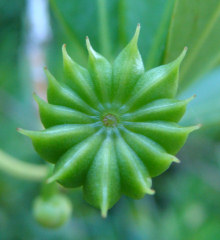 Yellow Anise has alternate, simple, olive-green, leaves, 2-6 in. long. In June and July, it produces inconspicuous (1/2 in. wide), yellow-green flowers with 6-12 petals on drooping flower stalks. The fruits develop into brown, star-shaped pods with many seeds. The twigs, leaves and flowers smell like anise (root beer or licorice odor). Florida Anise (Illicium floridanum), which is a frequently planted shrub, is native to the Florida Panhandle and is distinguished from Yellow Anise by its maroon flowers and sharp pointed leaves. All plant parts of Yellow Anise and Florida Anise are toxic.
Return to Shrubs and Vines List
|
